If you manage or own a commercial property, you already know how fast weeds can take over. One season, they’re just an eyesore; the next, they’re cracking concrete, hiding signage, and eating into your maintenance budget.
Weeds are a signal that your property’s being neglected. If you’re running a business, that can quickly turn into safety problems and costly repairs. An effective commercial weed control strategy helps you stay ahead of growth before it spreads.
What Commercial Weed Control Really Means
When people think of weed control, they picture someone spraying herbicide and calling it a day. But commercial weed control is more strategic. It’s a mix of prevention, targeted treatment, and year-round monitoring, all of which are designed to keep large-scale properties in compliance and looking professional.
You’ll find it used in places like:
- Retail centers and office parks
- Industrial lots and storage yards
- Utility corridors and right-of-ways
- Schools, HOAs, and municipal spaces
Each property faces different weed pressures, soil conditions, and regulations. The right plan has to balance all three.
Why Business Owners Can’t Ignore Weed Control
Weeds don’t wait for your schedule; they grow fast and cost you more the longer you ignore them. Every business owner eventually learns that maintenance is cheaper than recovery.
- Safety Risks: Overgrown vegetation blocks the line of sight, hides hazards, and increases fire danger.
- Liability: If a customer or employee gets hurt because of poor visibility or debris, it’s your problem.
- Regulations: Many cities have height limits and fire code requirements for vegetation. Neglect can mean fines.
- Operational Costs: It’s far cheaper to maintain a clean site than to reclaim one overrun with weeds.
So the question isn’t if you should manage weeds; it’s how you can do it smarter and more sustainably.
What are the 4 Methods of Controlling Weeds?
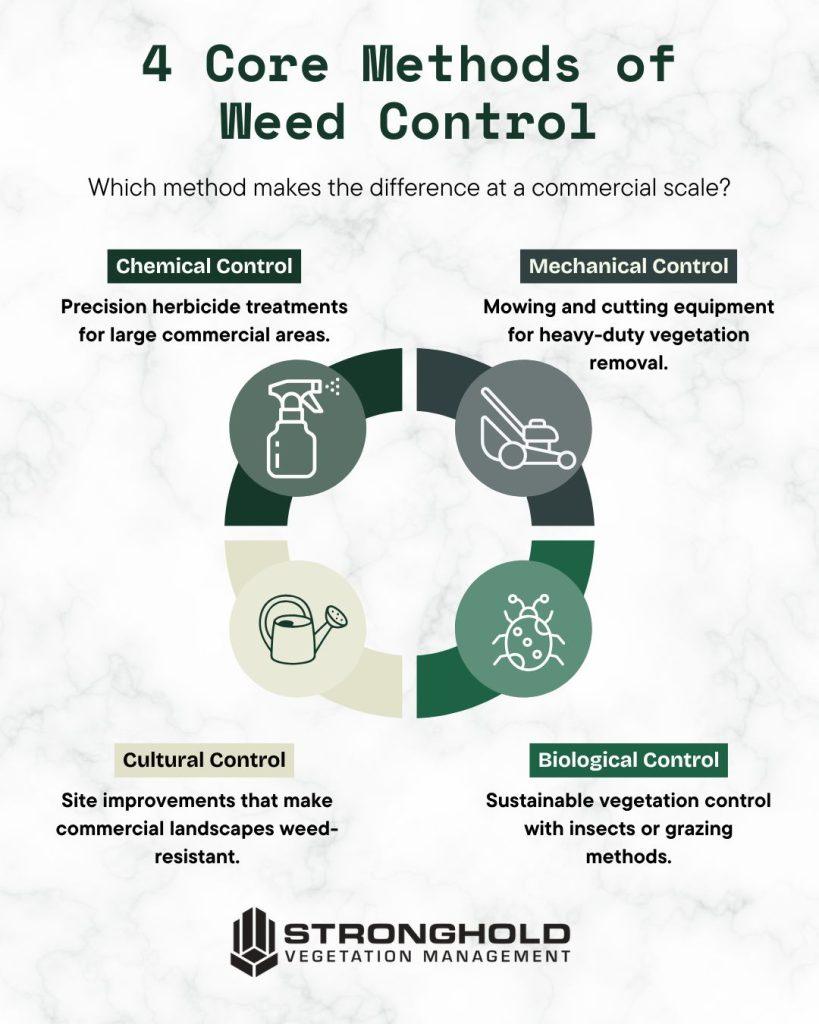
Commercial weed control uses four main methods: chemical, mechanical, cultural, and biological. Each plays a specific role in keeping large properties clean, compliant, and low-maintenance year-round.
1. Chemical Control
Chemical control is the most common and efficient method for commercial sites. Licensed professionals use herbicides: either pre-emergent (to prevent growth) or post-emergent (to eliminate active weeds).
These treatments are ideal for large areas like parking lots, industrial yards, or right-of-ways where manual removal isn’t practical. When applied correctly, chemical control delivers fast, lasting results with minimal disruption to daily operations.
2. Mechanical Control
Mechanical control involves physically removing or cutting weeds using tools or equipment such as mowers, trimmers, or tillers. It’s often used in areas where chemicals aren’t suitable, like near water systems, schools, or public spaces.
Regular mowing and edging also improve appearance and help prevent seed spread, making it a strong maintenance tool in combination with herbicide treatments.
3. Cultural Control
This method focuses on changing the environment to make it harder for weeds to grow. For commercial properties, that might mean adjusting irrigation schedules to reduce excess moisture, using mulch or gravel to block sunlight, or improving soil drainage.
By creating less favorable growing conditions, you reduce the need for constant chemical use while maintaining long-term control.
4. Biological Control
Biological control introduces natural competitors or predators — like insects, fungi, or grazing animals — to reduce weed populations.
While not common on every commercial site, it’s sometimes used on large open lands, utility corridors, or environmentally sensitive areas. It’s a sustainable, low-impact option that works best as part of an integrated weed management program.
Building a Year-Round Weed Control Plan
Treating weeds once a year may help for a few weeks, but it doesn’t stop regrowth or seed spread. A truly effective plan considers seasonal timing, site conditions, and long-term prevention.
Here’s how to build a program that keeps your property clean and compliant every month of the year.
1. Start with a thorough site evaluation.
Every property is different. Begin by walking the site and noting recurring issues, like fence lines, parking lot edges, curbs, and drainage zones. These areas usually trap moisture and debris, creating ideal conditions for weed germination.
A professional evaluation goes deeper than visual inspection. It should include:
- Identifying dominant weed species and their growth cycles
- Testing soil conditions that promote regrowth
- Assessing irrigation patterns and drainage efficiency
- Noting access limitations for equipment or treatment
Once you understand where and why weeds appear, you can tailor your control methods and avoid wasting product or labor.
2. Build a seasonal schedule.
Weed control is highly dependent on timing. Missing one application window can undo months of progress.
- Spring: Apply pre-emergent herbicides before temperatures rise and seeds begin to germinate. This step sets the foundation for the year.
- Summer: Follow up with post-emergent and spot treatments. During heat and irrigation cycles, weeds can reappear quickly, especially annual broadleaf and grassy species.
- Fall: Reapply pre-emergents to prevent winter weed cycles and reinforce bare-ground areas before rainfall returns.
- Winter: Inspect high-risk zones, clear debris, and plan adjustments for the next growing season.
3. Track your results.
Professional vegetation management is as much about data as it is about application. Keep records of what’s applied, when, and where. Include notes on weather conditions, product concentrations, and weed response rates.
This information helps identify patterns. For example, if a particular product performs better under certain temperatures, or if a specific area consistently regrows faster.
Over time, those records save money by refining application schedules and reducing the overuse of materials.
4. Monitor regularly and stay proactive.
Quarterly inspections are a simple but often overlooked step. A brief site walk can reveal early-stage growth long before it becomes a visible problem. It also helps identify irrigation leaks, compacted soil, or erosion that encourages weed growth.
For larger or multi-site operations, scheduling automated reminders or using digital tracking tools can keep inspections consistent.
Ask yourself this: if a potential client toured your property today, would they notice the care you put into maintenance or the weeds growing along your fence line? That answer tells you whether your weed control plan is working.
Mistakes That Cost Businesses Time and Money
Even experienced property and facility managers fall into predictable traps when managing vegetation. These mistakes don’t just waste effort; they cost thousands over time. Recognizing them early keeps your operation efficient and your property looking professional.
1. Skipping pre-emergent treatments.
Pre-emergents are the foundation of commercial weed control. Skipping this step allows seeds to germinate freely, forcing you into a constant cycle of reactive spraying. Once weeds are visible, the work (and cost) has already doubled.
2. Inconsistent service schedules.
Weeds don’t grow on your calendar. Missing one treatment — even by a few weeks — can let new growth take hold, especially after rain. Inconsistency is one of the top reasons long-term control programs fail.
3. Using the wrong herbicide or dosage.
Not all weeds respond to the same chemical family. Misidentifying a species or misapplying a product leads to poor results, chemical resistance, or damage to nearby plants. Always use selective herbicides when working around turf or ornamentals, and rely on licensed professionals for calibration and safety.
4. Ignoring irrigation and drainage issues.
Overwatering or poor drainage is a hidden driver of weed growth. Many species thrive in damp, compacted soil. If water is pooling near curbs or along concrete edges, no amount of spraying will solve the problem until drainage is fixed.
Even small oversights can undo months of progress. Read Top 7 Mistakes Businesses Make When Managing Weed Control for Lawns for more common errors companies make and the proven methods professionals use to avoid them.
Why Partnering with a Professional Matters
Managing weeds at a commercial scale isn’t the same as handling a backyard. Regulations, product safety, and application timing all matter. Working with a licensed team gives you:
- Consistent coverage
- Regulatory compliance
- Efficiency
- Safety
- Documentation
At Stronghold Vegetation Management, we take a proactive approach by inspecting, preventing, and maintaining your site so weeds never have the chance to take over again.
If you’re ready to create a custom weed control plan that fits your property and your budget, give us a call today. We’ll help you build a landscape that stays clean, compliant, and professional all year long.
The Bottom Line
Effective commercial weed control is about consistency, planning, and expertise. When done right, it reduces costs, keeps you compliant, and improves your property’s curb appeal year-round.